


Preparing Your Roof for Winter: A Surrey Homeowner’s Checklist
Quick Summary
- Preparing your roof for winter means checking tiles, gutters, flashing, chimney lead work and loft ventilation before the first named storm arrives.
- Aim to finish by the end of November.
- Most checks can be done safely from the ground and from inside your loft.
- Small repairs now cost far less than emergency call-outs in January.
- Anything involving ladders, steep pitches or flat roofs should go to a qualified roofer.
Did You Know? Winter 2025/26 was one of the wettest on record for southern England. Rainfall in the south was 58% above average, compared with 17% in the north. A roof that coped with an average winter may not cope with a wet one. v2radio
Why a Surrey Winter Is Hard on Roofs
One dramatic threat rarely faces Surrey roofs. The damage is from repetition: rain, wind, then a frost overnight, then rain again.
Water enters through small openings in tiles, mortar or flashing. It expands about 9 % when it freezes , which makes the gap wider . With the next thaw more water flows in. And that freeze-and-thaw cycle is how a hairline crack turns into a ceiling stain.
Saturated ground and heavy rain also mean gutters and downpipes work harder. The Met Office noted that saturated ground left southern and central England more sensitive to further wet weather. irishnews

The cost of getting it wrong is rising too. ABI figures show storm damage to homes rose 32% to £244 million in 2025, with the average storm payout reaching £2,450. insurancebusinessmag
From over 20 years of roofing across Surrey, the pattern is consistent. The emergency calls we get in January are rarely about new damage. They are almost always a small fault that was already there in October.
The Roof Winter Checklist
Work through this list in order. It runs from the outside in.
Area | What to look for | Who should do it | Priority |
Roof tiles and slates | Cracked, slipped or missing pieces; moss build-up | Roofer (or ground check with binoculars) | High |
Gutters and downpipes | Leaves, sagging sections, overflow stains on walls | Homeowner or roofer | High |
Chimney flashing and lead work | Lifted, cracked or gapped lead; crumbling mortar | Roofer | High |
Ridge and hip tiles | Loose or cracked mortar bedding | Roofer | High |
Velux and roof windows | Failed seals, cracked flashing, condensation between panes | Roofer | Medium |
Flat roofs | Ponding water, blistering, split seams | Roofer | High |
Loft interior | Damp patches, daylight through the roof, wet insulation | Homeowner | High |
Loft ventilation | Blocked eaves vents, condensation on rafters | Homeowner or roofer | Medium |
Overhanging trees | Branches touching the roof or dropping debris | Tree surgeon | Medium |
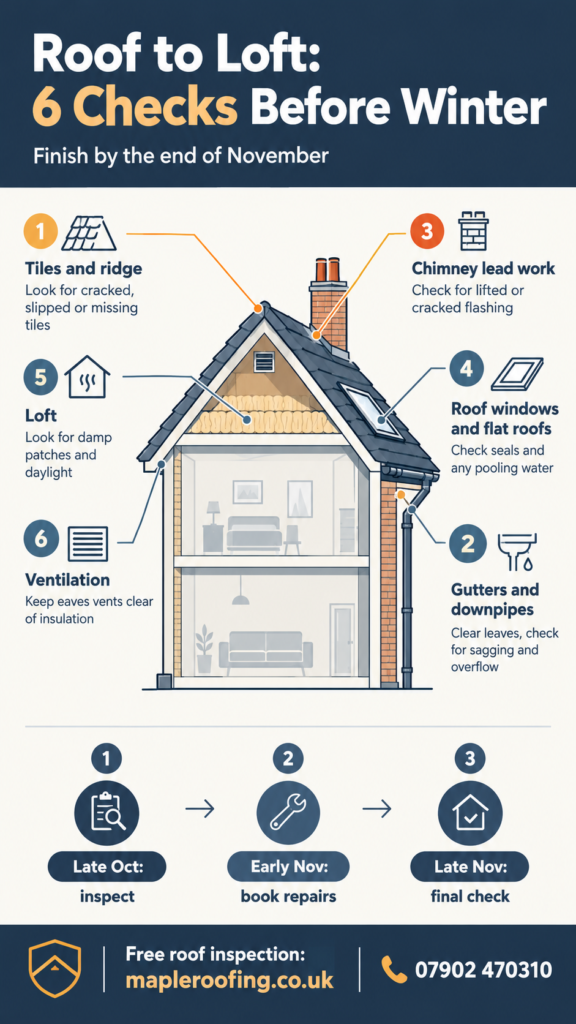
Tiles, ridges and slipped slates
Wind lifts loose tiles first. One missing tile exposes the felt beneath, and felt is not designed to take a full winter on its own. Ridge tiles matter just as much. Their mortar bedding is the first thing frost breaks down.
Gutters and downpipes
Blocked gutters send water over the edge and down your walls or behind the fascia. Clear them after most of the leaves have fallen, then check for sagging or leaking joints. The ABI also advises clearing gutters and securing roof tiles before a storm to limit damage. abi
Chimney flashing and lead work
This is the most common leak point we see. Lead expands and contracts with temperature, and over time it cracks or lifts. If your stack has not had chimney lead work checked in years, do it before winter.
Velux windows and flat roofs
Roof windows rely on their flashing kit and seals. If you see condensation trapped between panes or staining around the frame, get your Velux windows looked at. On flat roofs, look for pools of water that stay for more than 48 hours after rain. Ponding is a sign the membrane is under strain.
The loft check
Go up on a dry day with a torch. Look for damp patches on the underside of the roof, dark staining on timbers, wet insulation and any daylight showing through. Check that insulation does not block the eaves vents. Trapped moisture causes condensation, which can look like a leak but needs a different fix.