

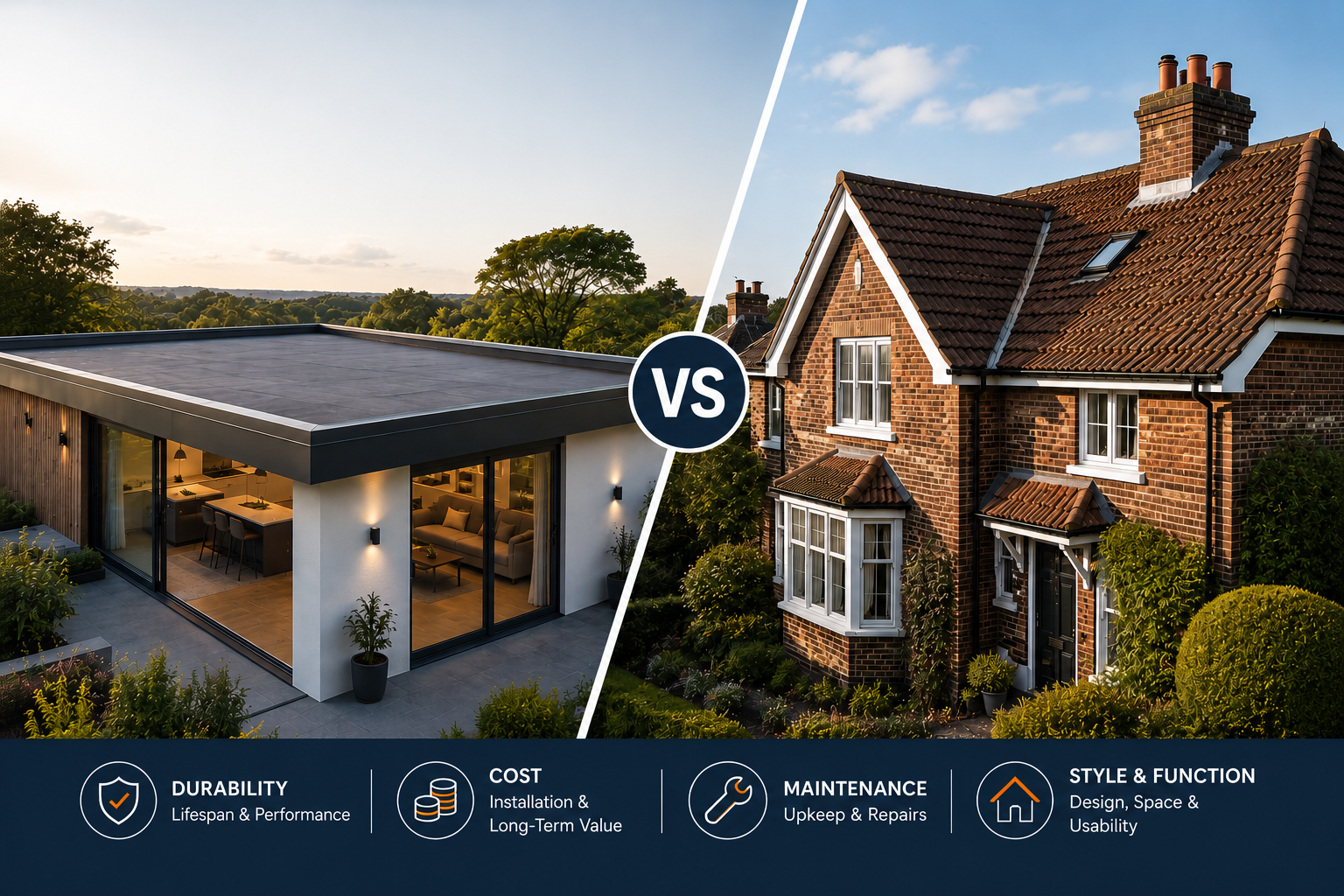
Flat Roof vs Pitched Roof: Which Is Better for Your Home?
Quick Summary
- Choosing between a flat roof and a pitched roof depends on your property type, budget, planning requirements, maintenance expectations, and long-term goals.
- Pitched roofs remain the most common roofing style across the UK due to their durability, effective water drainage, loft space potential, and compatibility with traditional British architecture.
- Flat roofs are widely used for extensions, garages, and modern developments because they are more affordable, maximise internal headroom, and suit contemporary architectural designs.
- One of the biggest advantages of pitched roofs is longevity, with natural slate capable of lasting up to 100 years and clay tiles commonly lasting 50 to 70 years.
- Flat roofs generally have shorter lifespans and require more regular maintenance due to drainage challenges and the risk of standing water.
- The guide explains that modern flat roof systems such as EPDM rubber and GRP fibreglass have significantly improved reliability and can perform well when professionally installed and maintained.
- Conservation areas and listed properties in Surrey often require pitched roofs to preserve the architectural character of the neighbourhood.
- Cost comparisons show flat roofs are generally cheaper to install upfront, while pitched roofs often deliver better long-term value because of their longer lifespan and lower maintenance needs.
- The blog recommends flat roofs for rear extensions, garages, rooftop terraces, and budget-conscious projects, while pitched roofs are better suited for main residential structures and long-term property investment.
- Many Surrey homes successfully combine both roof styles, using pitched roofs for the main structure and flat roofs for modern extensions or additions.
- The article also covers planning permission considerations, maintenance schedules, insulation performance, insurance implications, and the best roofing materials for UK homes.
Choosing between a flat roof and a pitched roof is one of the most consequential decisions you can make when building a new structure or replacing an existing one. Both roof types have genuine strengths, and both have real drawbacks. The right answer depends on your property, your budget, your local planning rules, and how you plan to use the space beneath.This guide sets out an honest, detailed comparison so you can make an informed decision before speaking to a contractor.
Did You Know?
According to the English Housing Survey, concrete tiles are the most common roof covering on UK dwellings, accounting for around 58 percent of the housing stock. Only about 16 percent of homes have clay tile roofs, and 13 percent have natural slate. This data from the government’s own housing research underlines why concrete tiles dominate the replacement market in Surrey, though the proportion of natural slate and clay tile roofs is higher in older conservation area properties. The same survey notes that some part of the roof was flat in a significant share of the housing stock, driven largely by rear extensions and garages.
Understanding the Basic Difference
A pitched roof has one or more sloping surfaces that meet at a ridge or hip. The angle, known as the pitch, is typically between 20 and 50 degrees on UK residential properties. Almost all traditionally built houses in Britain, including the vast majority of homes in Surrey, have pitched roofs.
A flat roof is not completely level but has a very shallow fall, usually between 1 and 5 degrees, to allow rainwater to drain. Flat roofs are common on extensions, garages, commercial buildings, and contemporary new-build homes.
The distinction matters because each type involves completely different materials, construction methods, drainage requirements, and maintenance needs.
Pitched Roofs: The Advantages
Longevity
A well-built pitched roof with quality tiles is one of the longest-lasting structures on a property. Natural slate roofs can last 80 to 100 years. Clay plain tiles typically last 50 to 70 years. Even concrete interlocking tiles, the workhorse of modern UK roofing, carry a lifespan of 30 to 50 years. Pitched roofs simply outlast flat roofs in almost every comparison.
Water Management
The slope of a pitched roof is its greatest practical advantage. Rain and snow shed naturally off the surface and into the guttering, dramatically reducing the risk of standing water and the problems it causes. Properly installed pitched roofs with adequate overhang and well-maintained gutters rarely suffer from water ingress through the roof surface itself.
Loft Space
A pitched roof creates a loft space beneath it. Depending on the pitch and the size of the property, that space may be usable as storage or, with appropriate conversion work, as a habitable room. Loft conversions add significant value to properties in Surrey and South West London, and a pitched roof is a prerequisite for most conversion types. A Velux window installation can further enhance the value and usability of that loft space once it is converted.
Lower Maintenance
Pitched roofs generally require less frequent maintenance than flat roofs. Individual damaged tiles can be replaced without disturbing the rest of the roof. Valleys, ridges, and flashings do need periodic attention, but the overall maintenance burden is lower over a typical ownership period. Our roof maintenance service is designed to keep pitched roofs performing well across every season.
Aesthetic Appeal
In most UK neighbourhoods, particularly those with Victorian, Edwardian, or traditional suburban architecture, a pitched roof is simply what looks right. Planning authorities in conservation areas and those dealing with listed buildings will almost always require a pitched roof to match the existing character of the street.
Pitched Roofs: The Disadvantages
Higher Upfront Cost
Building or replacing a pitched roof costs more than a flat roof of equivalent footprint. The additional structure, the larger surface area, and the cost of tiles or slates all contribute to a higher initial price.
More Complex Construction
Pitched roofs involve more structural elements: rafters, purlins, ridge boards, ceiling joists, and in older properties, a full cut-and-pitch timber frame. This complexity means more can go wrong and repairs can be more involved.
Limited Headroom in Loft Without Conversion
If the pitch is shallow or the house is small, the loft space may not be practically usable without significant works. In those cases, the “benefit” of the loft space is theoretical rather than real.
Flat Roofs: The Advantages
Lower Initial Cost
For a given footprint, a flat roof is cheaper to build than a pitched roof. There is less structural complexity, less material, and less labour involved. For extensions, garages, and outbuildings, this makes flat roofs an attractive and cost-effective option.
Easier Access for Maintenance and Installation
A flat roof is much easier to access for maintenance, HVAC installations, solar panels, and rooftop gardens. Many commercial properties and modern residential developments take advantage of this by using the roof surface itself as usable outdoor space.
Better Suited to Contemporary Architecture
Modern architectural styles, including the clean lines of contemporary extensions and single-storey additions, often look better with a flat roof. If you are extending a traditional house with a modern single-storey addition, a flat roof frequently blends more cleanly with the existing structure than attempting to match the pitch.
Space Efficiency
Because a flat roof sits directly above the ceiling, it maximises internal headroom. There is no wasted space beneath a roof structure that is too shallow to use.
Flat Roofs: The Disadvantages
Shorter Lifespan
This is the most significant drawback. Even modern flat roof systems have a lifespan that falls well short of a pitched roof. EPDM rubber membranes typically last 25 to 50 years if well maintained. GRP fibreglass roofs last 20 to 30 years. Traditional felt flat roofs, still found on many UK extensions, may need replacing after 10 to 15 years. Budget accordingly.
Drainage Challenges
Water does not shed from a flat roof the way it does from a pitched one. The shallow fall relies on correctly positioned outlets, and if those outlets become blocked with debris, standing water quickly accumulates. Ponding water is the primary cause of flat roof failure.
Greater Maintenance Requirement
Flat roofs need regular inspection and maintenance to catch membrane splits, seam failures, and blocked outlets before they become serious problems. Twice-yearly inspections are a sensible minimum.
Thermal Performance
Without careful design, flat roofs can perform poorly in terms of insulation. Modern warm roof constructions, where insulation sits above the structural deck, address this issue effectively, but older cold roof constructions with insulation between the joists are prone to condensation problems.
Which Performs Better in the UK Climate?
The UK’s frequent rainfall, coastal winds, and freeze-thaw cycles in winter create specific demands for any roof. Pitched roofs handle these conditions more naturally because of their inherent drainage properties. A well-built flat roof in good condition copes perfectly well with UK weather, but it requires more active management to stay in that condition.
In Surrey specifically, the combination of clay soils (which affect drainage around the building) and the relatively mild but consistently wet climate means that water management is a constant consideration. A pitched roof with properly maintained gutters and downpipes is the lower-maintenance option for most homeowners in this area. For advice tailored to Surbiton properties specifically, our guttering services ensure water is managed correctly whatever the roof type above.
Planning Permission and Conservation Area Considerations
In many parts of Surrey, including areas within the Royal Borough of Kingston upon Thames, local planning policies have strong views on roof types. Conservation areas typically require new roofs to match the character of surrounding properties, which in most residential streets means a pitched roof. If you are in a conservation area or your property is listed, check with your local authority before making any decision.
For extensions, permitted development rules allow many flat roof additions without planning permission, provided they meet specific criteria on height and size. Pitched roof extensions on the rear of most homes are also permitted development under standard conditions. Your local planning department or a qualified architect can confirm which rules apply to your specific property.
The Cost Comparison
As a general guide for Surrey homeowners in 2026:
Roof Type | Installation Cost (per m²) | Expected Lifespan |
|---|---|---|
Concrete tiles (pitched) | £70 to £100 | 30 to 50 years |
Clay tiles (pitched) | £90 to £140 | 50 to 70 years |
Natural slate (pitched) | £100 to £180 | 80 to 100 years |
EPDM rubber (flat) | £60 to £90 | 25 to 50 years |
GRP fibreglass (flat) | £65 to £95 | 20 to 30 years |
Traditional felt (flat) | £40 to £65 | 10 to 15 years |
When you factor in the longer lifespan of pitched roofing materials, the lifetime cost per year is often similar or lower despite the higher upfront investment.
When to Choose a Flat Roof
A flat roof makes most sense in the following situations:
- You are building a single-storey extension and want to maximise internal ceiling height
- You are replacing a garage or outbuilding roof on a budget
- The extension is at the rear of the property and the flat roof will not be visible from the street
- You want to incorporate a rooftop terrace or green roof into a contemporary design
- You are working within a tight budget on a project where longevity is less critical
Our flat roof service in Surbiton covers EPDM, GRP fibreglass, and torch-on systems for extensions, garages, and bay roofs across the area.
When to Choose a Pitched Roof
A pitched roof is usually the better choice when:
- You are reroofing or building the main house structure
- You want to maximise the long-term value and lifespan of the roof
- You intend to convert the loft at any point in the future
- You are in a conservation area or need planning permission
- You want the lowest possible ongoing maintenance commitment
- The property is a traditional style and visual coherence matters
Our roof installation service in Surbiton covers everything from standard concrete tile reroofs to full natural slate replacements on period properties.
The Verdict
For most UK homeowners replacing or building a main roof, a pitched roof is the stronger long-term choice. It lasts longer, requires less active maintenance, creates useful space, and suits the character of most British residential architecture.
For extensions, garages, and contemporary additions, a flat roof is often more practical and cost-effective, provided you choose a quality modern membrane system and commit to regular maintenance.
The choice is not always either/or. Many properties in Surrey successfully combine a pitched main roof with flat-roofed extensions. The key is matching the right roof type to the right part of the building.
Frequently Asked Questions
Can a flat roof be converted to a pitched roof? Yes, it is technically possible to convert a flat roof to a pitched roof, and some homeowners do this to improve longevity and appearance. It requires structural work to create the new timber frame and will almost always need planning permission, particularly at the front of a property or in a conservation area. The cost is higher than a like-for-like flat roof replacement, so it is worth weighing up the long-term benefits carefully.
How often should a flat roof be inspected? A flat roof should be inspected at least twice a year, ideally in autumn before heavy leaf fall and in early spring after the freeze-thaw season. Pay particular attention to outlets, drains, seams, and the perimeter edges where the membrane meets abutting walls. Catching small issues early prevents them from becoming expensive failures.
Is a flat roof more likely to leak than a pitched roof? In general, yes, if not properly maintained. Flat roofs rely on the integrity of the membrane and the correct fall to drain water. A pitched roof sheds water naturally and has less reliance on perfect installation conditions. However, a high-quality modern flat roof installed by an experienced contractor and kept clear of debris can perform very reliably.
Does a flat roof affect home insurance premiums? Some insurers apply a higher premium to properties with flat roofs, particularly traditional felt flat roofs, because they are statistically more prone to claims. Homes with modern EPDM or GRP systems may attract lower premiums than those with old felt. It is worth disclosing your roof type accurately and asking your insurer specifically whether the material affects your premium.
Which flat roof material has the longest lifespan? EPDM rubber membrane is currently the most durable option for domestic flat roofs, with a realistic lifespan of 25 to 50 years when correctly installed. GRP fibreglass is strong and seamless, typically lasting 20 to 30 years. Traditional three-layer felt has the shortest lifespan at 10 to 20 years and is increasingly being replaced with modern systems at the first opportunity.
Can a pitched roof be insulated without replacing it? Yes. Loft insulation can be added or upgraded without disturbing the roof covering itself. Cold roof insulation between and over the joists at ceiling level is the most common approach in existing homes and does not require any roofing work. If the roof is being replaced, this is the ideal moment to install a modern breathable underlayment and consider upgrading the insulation at the same time.
What is the best flat roof system for a rear extension in Surrey? EPDM is the most widely recommended system for domestic extensions in the South East. It is flexible, UV-resistant, and performs reliably in the UK climate. GRP fibreglass is the preferred choice where a hard, walk-on surface is required, such as for a roof terrace. Both options significantly outlast traditional felt and carry manufacturer guarantees of 20 years or more.
If you are weighing up roof options for your home in Surrey or South West London, the team at Maple Roofing can give you an honest assessment of what will work best for your specific property. Contact us for a free consultation.