

Roof Repair vs Roof Replacement: How to Know Which You Need
A cracked tile does not always mean a new roof, and a small leak does not always mean a simple fix. Get this call wrong and you either pay for a full replacement you did not need, or you patch a roof that was already past saving and pay for the same job twice.
The short answer: if the damage is localised, the roof is under 20 to 25 years old, and the repair quote is less than 30% of a full replacement cost, repair it. If you have had three or more callouts in the last five years, the roof is nearing the end of its material lifespan, or the underlay has failed, replacement is the better investment. The rest of this guide walks through exactly how to tell which situation you are in.
Repair vs Replacement: The Core Difference
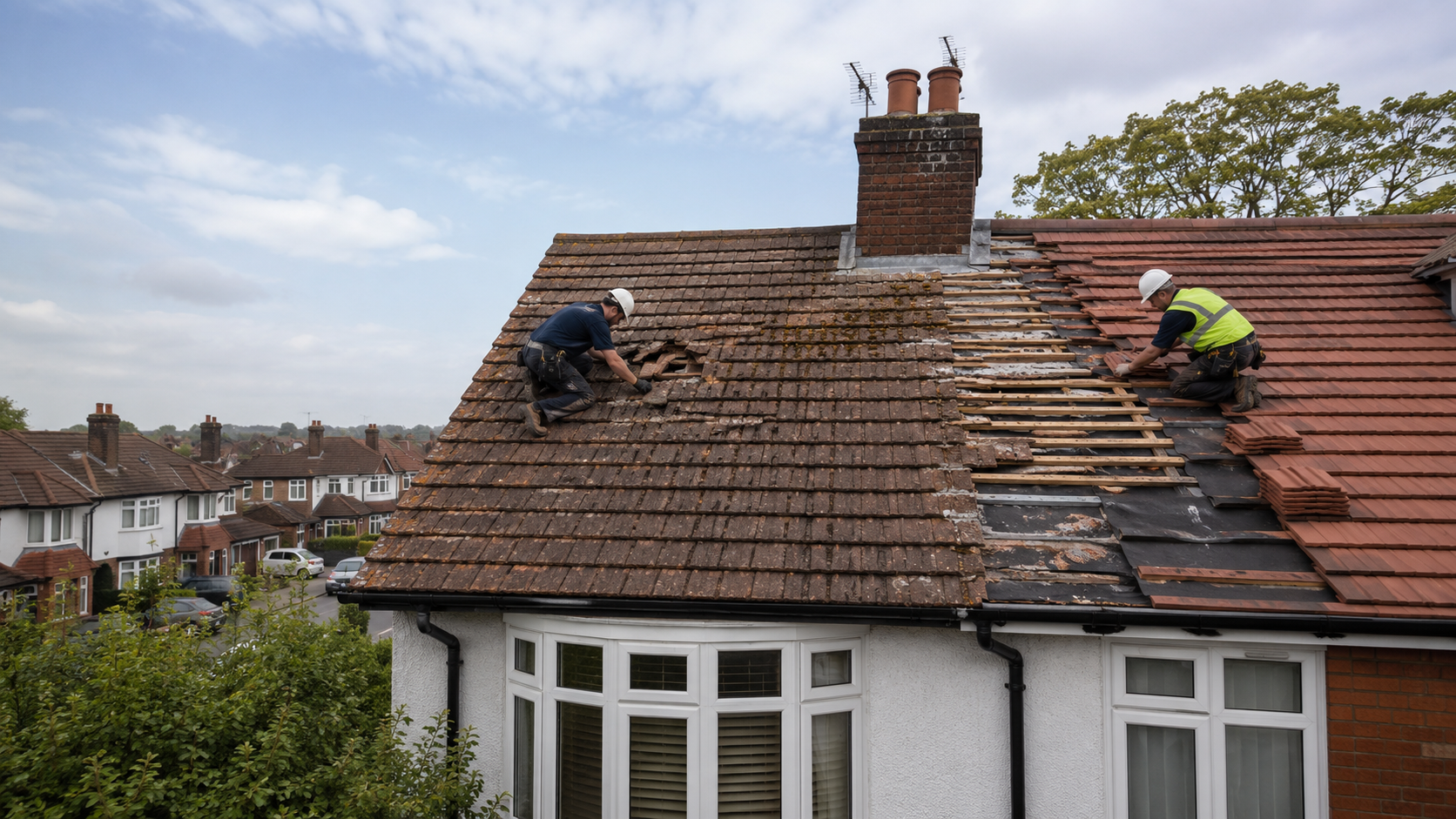
A roof repair fixes a specific, localised problem while leaving the rest of the structure in place. Think a cracked tile, a section of failed flashing, or a blocked valley. A roof replacement strips the covering back to the rafters and rebuilds the whole system: underlay, battens, tiles, and flashing.
The confusion usually comes from cost. A £2,000 repair looks cheaper than an £8,000 replacement on paper. But if that roof needs another repair in two years, and another after that, each one bringing its own scaffolding bill, the maths changes quickly. We cover exactly where that tipping point sits further down.
Not Sure Which Side of That Line Your Roof Falls On?
The right call depends on more than what you can see from the ground. Roof age, underlay condition, and how many repairs it has already had all factor into whether a patch job will hold or whether it is time to rebuild. Our team will inspect your roof, tell you honestly which category it falls into, and give you a written quote for both options so the decision is yours to make with the full picture.
A roof repair fixes a specific, localised problem while leaving the rest of the structure in place. Think a cracked tile, a section of failed flashing, or a blocked valley. A roof replacement strips the covering back to the rafters and rebuilds the whole system: underlay, battens, tiles, and flashing.
The confusion usually comes from cost. A £2,000 repair looks cheaper than an £8,000 replacement on paper. But if that roof needs another repair in two years, and another after that, each one bringing its own scaffolding bill, the maths changes quickly. We cover exactly where that tipping point sits further down.
Signs You Only Need a Repair
Repair is usually the right call when the problem is contained and the rest of the roof structure is sound.
- A handful of slipped, cracked, or missing tiles in one area
- A single leak with a clear, traceable source (flashing, a valley, a chimney joint)
- Roof age under 20 to 25 years for tiled roofs, or under 10 years for a flat roof
- No daylight visible through the underlay when you check from the loft
- No sagging, no widespread staining, and no soft or spongy sections underfoot
Did You Know? Scaffolding hire alone can cost between £625 and £1,500 per elevation depending on the setup. Two separate repair visits over a few years can rack up nearly as much in access costs as a full re-roof, before a single tile is replaced.
Signs You Need a Full Replacement
Replacement becomes the sensible option once the damage is no longer isolated, or once the roof has simply reached the end of its working life. Our detailed breakdown of 10 signs your home needs a new roof goes deeper into each of these, but the main ones are:
- Three or more repair callouts in the past five years
- Daylight visible through the roof boards or underlay on a dry day
- Sagging in the roofline, which usually points to a structural timber issue
- Widespread tile erosion, cracking, or granule loss across the whole roof
- The felt or underlay has perished (common on roofs installed before the 1990s using bitumen felt)
- The roof is approaching or has passed its material’s expected lifespan
You cannot patch rotten underlay. If it has failed, the tiles have to come off entirely to replace it, which is effectively a full re-roof regardless of how the tiles themselves look.
2026 Cost Comparison: Repair vs Replacement
Here is how UK roof repair and replacement costs break down in 2026, based on current industry pricing data.
| Job Type | Typical Cost (2026) | Notes |
|---|---|---|
| Minor tile repair (1 to 5 tiles) | £150 to £400 | Ladder access, no scaffolding needed |
| Ridge tile repointing | £280 to £700 | Cost rises for longer runs or dry-ridge conversion |
| Valley repair | £350 to £1,200 | Higher end for full valley lining replacement |
| Chimney flashing and leadwork | £300 to £1,000+ | Scaffolding often required |
| Average UK roof repair (overall) | Around £530 | Wide range depending on scope |
| Scaffolding hire (per elevation) | £800 to £1,500 | Often the hidden cost of repeat repairs |
| Full pitched roof replacement | £5,500 to £12,500 | Standard 3-bed semi-detached, materials dependent |
| Full replacement, larger or slate roof | Up to £19,000 | Larger properties or premium materials |
Our roof repair costs in Surrey guide and complete guide to roof replacement in Surrey break these figures down further by property type. You can also run your own numbers using our roof installation cost calculator before booking an inspection.
The 30% Rule Roofers Use to Decide
Most experienced roofers work to a simple threshold: if a single repair quote comes in above 30% of a full replacement cost, replacement is usually the better long-term value.
Here is why. Two repair visits over five years, each needing scaffolding, can easily total £3,000 to £4,000 in combined labour and access costs before a single tile is replaced. A full replacement uses that same scaffolding once, for a job that then lasts 40 to 60 years depending on material. Repeated patching does not just cost more per repair, it stacks access costs that a single replacement avoids entirely.
Pro tip: Ask any roofer quoting a repair to also give you a rough replacement estimate for comparison. A reputable contractor will do this without hesitation. If they will not, or if they push replacement without explaining why repair will not hold, get a second opinion.
How Your Roof Material Affects the Decision
The material your roof is covered in changes where that 20 to 25 year decision point sits. A concrete tile roof from the 1990s and a natural slate roof from the 1920s are in very different stages of their working life, even if both look tired.
| Material | Typical Lifespan | Decision Point |
|---|---|---|
| Concrete tiles | 40 to 60 years | Repair under 25 years old; reassess after 40 |
| Clay tiles | 60 to 100 years | Repair viable for longer; underlay usually fails first |
| Natural slate | 70 to 150 years | Slate itself rarely fails; nails and battens usually do |
| Felt (traditional) | 10 to 15 years | Short lifespan; replacement often more cost-effective |
| EPDM rubber (flat roof) | Around 30 years | Compare with EPDM vs GRP before replacing |
| GRP fibreglass (flat roof) | 25 to 30 years | See our flat roof services page |
Why UK Weather Is Changing This Calculation
UK weather has become a bigger factor in this decision than it was even five years ago. According to the Association of British Insurers, insurers paid out £1.2 billion in weather-related property claims in 2025, a 14% increase on 2024. Storm damage to homes alone reached £244 million, up 32% year on year, with the average storm damage payout rising to £2,450.
That trend matters directly for the repair-or-replace decision. A roof that could comfortably absorb the odd storm ten years ago may now be taking more frequent hits, which shortens the realistic gap between repairs. Our guide on how UK weather affects roof lifespan goes into more detail on how rainfall patterns and storm frequency in the South East are shifting these timelines.
If storm damage is the cause of your current issue, check your buildings insurance before paying out of pocket. Wear and tear generally is not covered, but sudden storm damage usually is.
Common Mistakes Homeowners Make
- Treating quick fixes as permanent solutions. Sealant and flashing tape rarely last more than a winter or two. They buy time, not a fix.
- Getting only one quote. Repair and replacement pricing varies significantly by roofer. Two or three quotes on any job over £1,000 is standard practice.
- Ignoring the loft. Water marks, daylight through the boards, or a damp smell in the loft are often the clearest early warning signs, and they are free to check yourself.
- Assuming age alone decides it. A well-maintained 60-year-old slate roof can outlast a poorly installed 15-year-old concrete tile roof. Condition matters as much as age.
- Delaying once daylight is visible through the underlay. At that point, repair is no longer realistic and the delay usually adds timber and insulation damage to the final bill.
Based on the roofs we have assessed across Surbiton, Kingston, and Twickenham over the years, the single most expensive mistake is delay. A £400 repair ignored for two winters commonly turns into a £1,500 repair, and a £1,500 repair ignored long enough turns into a full replacement anyway, just at a worse time and often with water damage to the timber or ceiling below added on top.
Getting a Professional Assessment
None of the guidance above replaces an actual inspection. A roofer needs to get onto the roof, and often into the loft, because the visible symptom inside the house does not always point to the true source of the problem.
If you are in Surbiton, Kingston upon Thames, Wimbledon, or Twickenham, our team carries out full roof assessments and gives you a straight answer on repair versus replacement, along with a written quote for both so you can compare. We also handle related work such as guttering, chimney and lead work, and Velux window installation, all of which can affect how long a repair actually holds.
FAQs
Is it ever cheaper to repair a roof three times rather than replace it once? Rarely, once scaffolding is factored in. Three repairs over five years, each requiring access equipment, often add up to a meaningful portion of a full replacement cost, without extending the roof’s overall life by much.
Can I repair just part of a roof and leave the rest? Yes, if the damage is genuinely localised and the rest of the roof is in good condition. This is common and often the right call. Problems arise when a partial repair is used to avoid addressing a roof that is failing more broadly.
How do I know if my roof leak is from the roof itself or something else? Condensation, plumbing, and roof leaks can all cause similar staining. A professional inspection is the only reliable way to confirm the source before paying for either a repair or a replacement.
Does home insurance cover roof replacement? Insurance generally covers sudden, insured events like storm damage, not gradual wear and tear or age-related deterioration. Check your policy wording and, if the damage followed a storm, gather photos and a roofer’s report as evidence.
How long does a full roof replacement take? A standard semi-detached pitched roof typically takes 3 to 7 days, weather permitting. Larger or more complex roofs take longer.
What is the average lifespan of a roof in the UK? It depends entirely on material. Concrete tiles run 40 to 60 years, clay tiles 60 to 100 years, and natural slate can exceed 100 years with proper maintenance.
Should I replace my roof before selling my house? Only if it is already showing clear signs of failure. A roof in good repair condition rarely needs replacing purely for a sale, and a survey will usually flag it if buyers need reassurance either way.